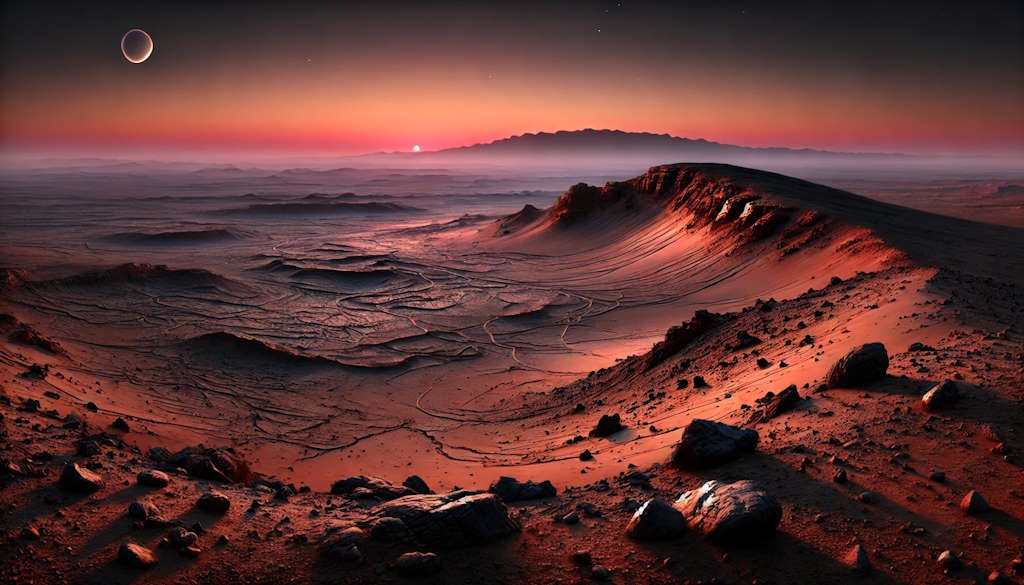
 Karlobag.eu / AI illustration
AI illustration — this image is not a real photograph and does not depict an actual event. What does AI illustration mean?
Mars, our neighboring planet, has always been a fascination for scientists due to its possible past that may have included liquid water and potentially habitable conditions for life. Today, thanks to NASA's Curiosity mission, we have increasing insights into the processes that transformed Mars from a planet that might have been able to support life into the hostile environment we know today. These discoveries provide scientists with crucial data about how Mars lost its atmosphere and what climatic conditions prevailed billions of years ago.
The Curiosity rover, which is exploring Gale Crater, has discovered carbonates rich in carbon whose isotopic composition indicates extreme evaporation conditions. This discovery suggests that these minerals formed under conditions that only supported transient liquid water, which was a key indicator of climatic changes on Mars. According to data from NASA, these carbonates were likely formed during cycles of drying and wetting within Gale Crater or in very salty waters at low temperatures, which promoted ice formation.
Climate Change on Mars
Climate scenarios being considered include alternation between more favorable and less favorable conditions for life. Drying and wetting cycles could have allowed for temporary conditions that were more conducive to life, while low temperatures combined with high salinity created an inhospitable environment where water was trapped in the form of ice, and the liquid water was too salty to support biological life. These results support theories previously proposed, but now confirmed by isotopic evidence from real rock samples.
The Significance of Carbonates and Isotopes
Carbonates are key minerals because they can preserve climate records of the conditions under which they formed. By analyzing the ratios of carbon and oxygen isotopes in these minerals, scientists can reconstruct the history of Mars's climate. For example, heavier carbon and oxygen isotopes remain in the rock while lighter ones evaporate, creating unique signatures of the history of water evaporation on Mars. The heavier isotopic values found on Mars are significantly greater than those on Earth, indicating that Mars underwent extreme evaporation processes before it became the cold, dry desert it is today.
According to scientist David Burt, the isotopic values of these carbonates point to processes that were pushed to extremes, further confirming theories of dramatic climatic changes on Mars. This research has provided new insights into how the conditions for life on the Martian surface have changed and how there may have been temporary conditions suitable for microbiological life in subsurface layers or during brief time periods in the past.
The Technology Behind the Discoveries
All these discoveries were made using sophisticated instruments on the Curiosity rover. The SAM (Sample Analysis at Mars) instrument heats rock samples to nearly 900 degrees Celsius to release gases, which are then analyzed using the TLS (Tunable Laser Spectrometer) instrument. These instruments allow for the analysis of the chemical composition of Mars's surface and atmosphere, providing scientists with key data about the past of this planet.
These discoveries not only unveil the past of Mars but also enable a better understanding of how similar processes might occur on other planets and locations within our solar system. Each new piece of data contributes to the puzzle of how Mars became a hostile planet and how climate change has affected its ability to support life in the past.
NASA's Curiosity rover continues its mission, uncovering new secrets of the Red Planet that will help us better understand the past, present, and potentially future of Mars. This mission is of exceptional importance not only for Mars but for all humanity as it brings us closer to answering the question: Could Mars ever have supported life, and can it do so again in the future?
Source: NASA
Note: This content was prepared with the assistance of artificial intelligence tools. The content was editorially reviewed before publication.