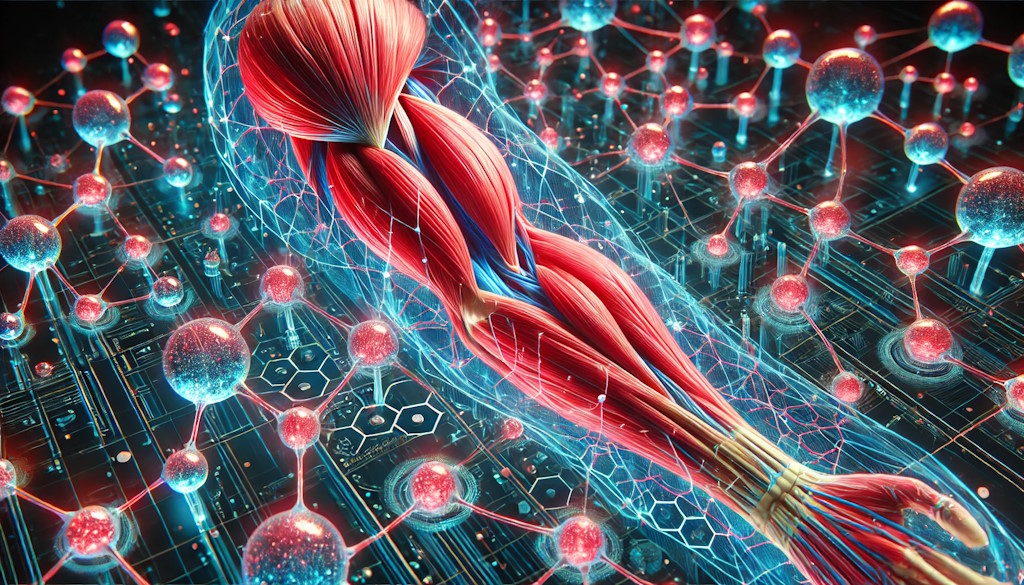
 Karlobag.eu / AI illustration
AI illustration — this image is not a real photograph and does not depict an actual event. What does AI illustration mean?
According to research from the University of Michigan, the speed of muscle contraction depends on the flow of water within muscle fibers.
Although it is known that muscles, like all other cells, contain about 70% water, scientists are still investigating what determines the limits and maximum performance of muscles. Previous research has mostly focused on the molecular level of muscle work, neglecting the three-dimensional structure and presence of fluid in muscle fibers.
New theory on muscle elasticity
Physicist Suraj Shankar from the University of Michigan, along with Harvard physics professor L. Mahadevan, developed a theoretical model describing the role of water in muscle contraction. This model shows that the way fluid passes through muscle fibers determines the speed of their contraction.
Their research discovered a new type of elasticity, called strange elasticity, which allows muscles to generate force through three-dimensional deformations. This elasticity is visible in the common phenomenon of muscle fiber bulging vertically as it contracts along its length.
Application to other cells and tissues
Scientists point out that this framework can be applied to many other cells and tissues that are also mostly composed of water. The findings, published in the journal Nature Physics, could impact the design of soft actuators, fast artificial muscles, and shape-changing materials, which currently have very slow contraction speeds because they are externally activated.
Active sponge
Researchers envisioned each muscle fiber as an active sponge filled with water that can contract and squeeze through the action of molecular motors. Muscle fibers consist of many components, including various proteins, cell nuclei, organelles such as mitochondria, and molecular motors like myosin, which convert chemical energy into movement.
Upper limits of contraction speed
Since the process of squeezing requires time to move water, scientists hypothesized that the movement of water through the muscle fiber sets the upper limit of muscle twitch speed. They tested their theory by modeling muscle movements in various organisms, including mammals, insects, birds, fish, and reptiles.
Control of rapid movements in smaller organisms
They found that muscles producing sound, such as the rattle in a rattlesnake's tail, do not depend on fluid flow and are controlled by the nervous system. In smaller organisms, such as flying insects that flap their wings several hundred to a thousand times per second, fluid flow within muscle fibers plays a more significant role.
Active elastic motor
When muscle fibers act as active sponges, the process also causes muscles to act as active elastic motors. Muscles exhibit a new property called "strange elasticity," where their response to squeezing in one direction is not the same as in another. This property allows muscle fibers to generate force from repetitive deformations, behaving like a soft motor.
Reevaluating muscle function
These results challenge previous thinking that focused on molecular details, neglecting the fact that muscles are long, filamentous, hydrated, and function on multiple levels. Overall, their results suggest the need for a revised view of muscle function to better understand their physiology.
Source: University of Michigan
Note: This content was prepared with the assistance of artificial intelligence tools. The content was editorially reviewed before publication.