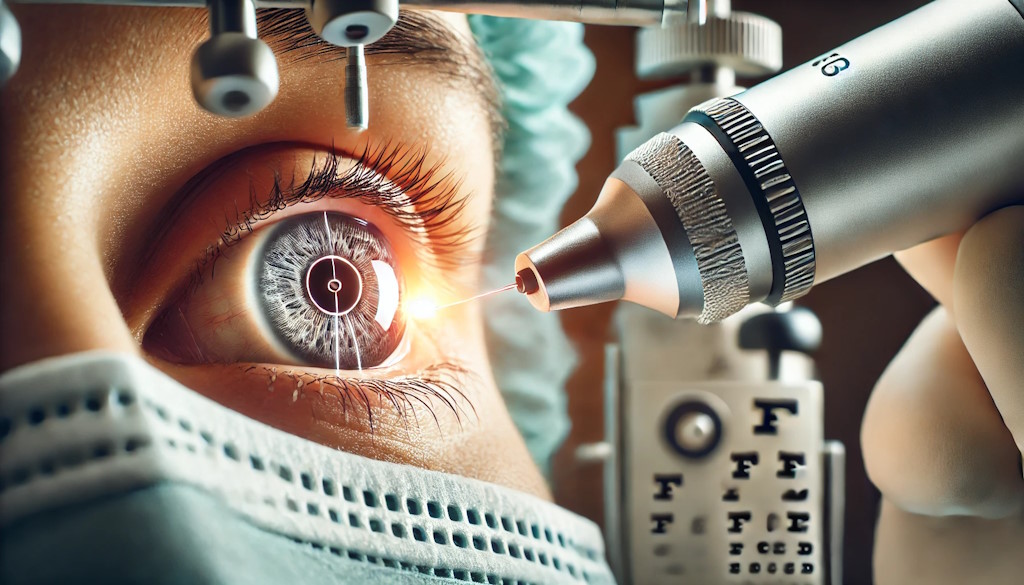
 Karlobag.eu / AI illustration
AI illustration — this image is not a real photograph and does not depict an actual event. What does AI illustration mean?
Surgeons can correct certain vision problems by altering the shape of the eye to better focus light.
Although procedures such as laser treatments are typically very safe, some patients experience pain long after surgery.
In a new study published in the ACS Journal of Proteome Research, scientists examined changes in proteins in patients' tears associated with pain occurring months after surgery.
The analysis suggests that changes in the quantities of specific groups of proteins on day one may help identify individuals at increased risk.
When the eye fails to properly focus light on the sensory cells of the retina, it results in poor vision.
In procedures such as laser vision correction (LASIK) and photorefractive keratectomy (PRK), surgeons use lasers to change the path of light traveling to the retina by altering the shape of the cornea, the eye's transparent covering.
Pain is common in the first days after the procedure, but sometimes it can persist longer.
Researchers suspect that such prolonged pain may be related to changes in the environment immediately around the corneal nerves, including tears that lubricate the eye.
Sue Aicher, Brooke Harkness, Anat Galor, and their colleagues decided to comprehensively study proteins in tears in search of potential predictors of postoperative eye pain.
The team began recruiting individuals scheduled for LASIK or PRK surgery on both eyes at clinics in Portland, Oregon, and Miami.
The analysis focused on tears from 16 patients who reported a pain level of at least three out of ten three months after surgery and 32 patients who did not report postoperative pain after three months.
Researchers identified a set of 2,748 proteins in tears from all participants before surgery, one day after surgery, and three months after surgery.
When the team compared the protein profiles of the two groups of patients, they focused on 83 proteins whose levels changed in patients with postoperative pain.
Using statistical tools, Aicher's team tested whether individual proteins or groups of proteins can predict whether patients will experience long-term pain after eye surgery.
Computer models using groups of three or four proteins proved most effective in predicting prolonged discomfort.
Such patterns of protein differences, researchers say, may one day serve to assess patients' risk of postoperative eye pain and find new treatment methods.
The authors acknowledge funding from the National Institutes of Health (NIH) National Eye Institute (NEI) of the USA.
Source: American Chemical Society
Note: This content was prepared with the assistance of artificial intelligence tools. The content was editorially reviewed before publication.