Postavke privatnosti

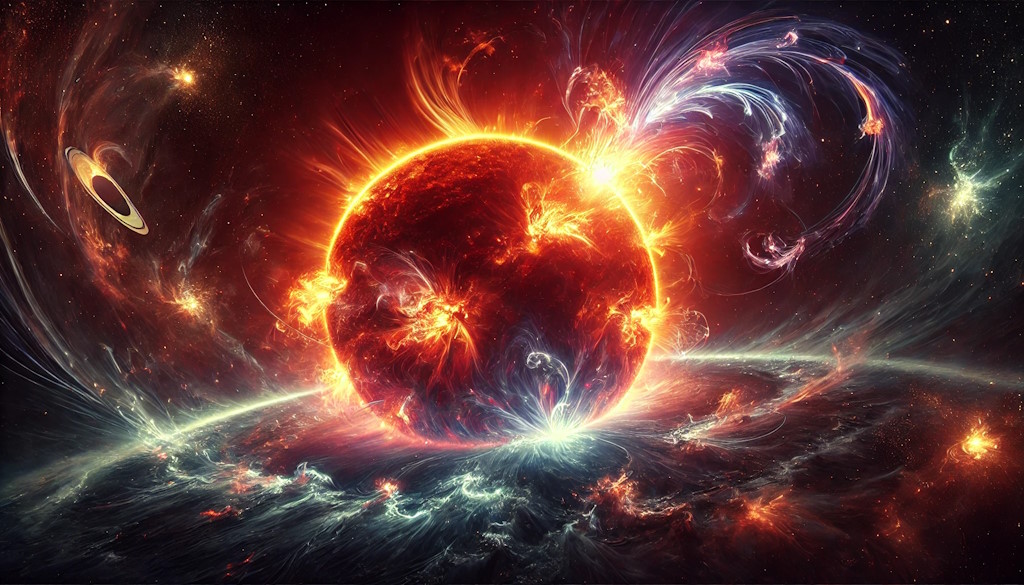
Progress in predicting solar eruptions: accurate predictions of velocity and arrival of coronal mass ejections allow for better warning and protection of ground technology

Scientists have made significant progress in predicting space storms, allowing more accurate predictions of the speed and arrival of coronal mass ejections (CMEs) to Earth. These discoveries help protect the critical infrastructure and technology we use every day, making our space weather preparations more efficient.

Progress in predicting solar eruptions: accurate predictions of velocity and arrival of coronal mass ejections allow for better warning and protection of ground technology
Photo by: Domagoj Skledar/ arhiva (vlastita)

Scientists have made a significant breakthrough in predicting space storms, enabling more accurate forecasts of when a violent solar eruption might strike Earth.

Research now allows the prediction of the exact speed of coronal mass ejections (CMEs) and the timing of their impact on our planet, even before they fully erupt from the Sun.

CMEs are bursts of gas and magnetic fields ejected into space from the Sun's atmosphere. They can cause geomagnetic storms that can disrupt technology in Earth's orbit and on the surface, which is why experts worldwide are working to improve space weather forecasts.

According to researchers from Aberystwyth University, advancements in this field could significantly help protect the infrastructure crucial to our daily lives. They will present their findings today at the Royal Astronomical Society's National Astronomy Meeting in Hull.

It has been found that specific areas on the Sun, called 'active regions,' are key to understanding the formation of CMEs. These regions have strong magnetic fields that change before, during, and after the eruption.

Critical Height of Active Regions
A key aspect of the research was the "critical height" of active regions, which is the height at which the magnetic field becomes unstable and can lead to a CME. Harshita Gandhi, a solar physicist from Aberystwyth University, explains that measuring the strength of the magnetic field with height can determine this critical height.

"Using this data along with a geometric model, we can track the actual speed of a CME in three dimensions, which is crucial for accurate forecasts," says Gandhi.

Their findings show a strong correlation between the critical height at the onset of a CME and its actual speed. This allows the prediction of the CME's speed and its arrival time at Earth even before it fully erupts.

Impact on Earth
When CMEs hit Earth, they can cause geomagnetic storms that create spectacular auroras, known as the northern lights. However, these storms can also disrupt key systems we rely on daily, such as satellites, power grids, and communication networks.

Therefore, scientists around the world are working to improve our ability to predict when CMEs will hit Earth. More accurate predictions of CME speed shortly after an eruption allow for better advance warnings.

Gandhi emphasizes that understanding and utilizing critical height in forecasts improves the ability to warn of incoming CMEs, thus helping to protect the technology we depend on in modern life.

Improving Space Weather Forecasts
"The research not only enhances our understanding of the Sun's explosive behavior but also significantly improves our ability to predict space weather events," says Gandhi.

"This means better preparedness and protection for the technological systems we rely on every day."

Advancements in space storm forecasting have the potential to greatly enhance our ability to protect critical infrastructure and technology. With a better understanding of the critical heights of active regions on the Sun, scientists can more accurately predict the speed and arrival of CMEs, allowing for timely warnings and better preparedness for potential geomagnetic storms.

These new insights come at a crucial time, as space weather becomes increasingly important with growing dependence on satellites and communication networks. Scientists hope that their methods will improve global forecasts and enable better strategies for protecting infrastructure.

Aberystwyth University plans to continue its research, focusing on further improving models and methods for space weather prediction. The scientific community eagerly anticipates further discoveries that will secure our technological future.

Ultimately, precise space weather forecasts not only help protect technology but also contribute to a better understanding of the complex processes governing the behavior of our Sun and its impact on Earth.

This significant advancement in space weather science can ensure that we are better prepared for future solar eruptions, reducing risks and protecting vital technologies we use daily.

Source: Royal Astronomical Society

Find accommodation nearby

Creation time: 21 July, 2024

Science & tech desk

Our Science and Technology Editorial Desk was born from a long-standing passion for exploring, interpreting, and bringing complex topics closer to everyday readers. It is written by employees and volunteers who have followed the development of science and technological innovation for decades, from laboratory discoveries to solutions that change daily life. Although we write in the plural, every article is authored by a real person with extensive editorial and journalistic experience, and deep respect for facts and verifiable information.

Our editorial team bases its work on the belief that science is strongest when it is accessible to everyone. That is why we strive for clarity, precision, and readability, without oversimplifying in a way that would compromise the quality of the content. We often spend hours studying research papers, technical documents, and expert sources in order to present each topic in a way that will interest rather than burden the reader. In every article, we aim to connect scientific insights with real life, showing how ideas from research centres, universities, and technology labs shape the world around us.

Our long experience in journalism allows us to recognize what is truly important for the reader, whether it is progress in artificial intelligence, medical breakthroughs, energy solutions, space missions, or devices that enter our everyday lives before we even imagine their possibilities. Our view of technology is not purely technical; we are also interested in the human stories behind major advances – researchers who spend years completing projects, engineers who turn ideas into functional systems, and visionaries who push the boundaries of what is possible.

A strong sense of responsibility guides our work as well. We want readers to trust the information we provide, so we verify sources, compare data, and avoid rushing to publish when something is not fully clear. Trust is built more slowly than news is written, but we believe that only such journalism has lasting value.

To us, technology is more than devices, and science is more than theory. These are fields that drive progress, shape society, and create new opportunities for everyone who wants to understand how the world works today and where it is heading tomorrow. That is why we approach every topic with seriousness but also with curiosity, because curiosity opens the door to the best stories.

Our mission is to bring readers closer to a world that is changing faster than ever before, with the conviction that quality journalism can be a bridge between experts, innovators, and all those who want to understand what happens behind the headlines. In this we see our true task: to transform the complex into the understandable, the distant into the familiar, and the unknown into the inspiring.

NOTE FOR OUR READERS
Karlobag.eu provides news, analyses and information on global events and topics of interest to readers worldwide. All published information is for informational purposes only.
We emphasize that we are not experts in scientific, medical, financial or legal fields. Therefore, before making any decisions based on the information from our portal, we recommend that you consult with qualified experts.
Karlobag.eu may contain links to external third-party sites, including affiliate links and sponsored content. If you purchase a product or service through these links, we may earn a commission. We have no control over the content or policies of these sites and assume no responsibility for their accuracy, availability or any transactions conducted through them.
If we publish information about events or ticket sales, please note that we do not sell tickets either directly or via intermediaries. Our portal solely informs readers about events and purchasing opportunities through external sales platforms. We connect readers with partners offering ticket sales services, but do not guarantee their availability, prices or purchase conditions. All ticket information is obtained from third parties and may be subject to change without prior notice. We recommend that you thoroughly check the sales conditions with the selected partner before any purchase, as the Karlobag.eu portal does not assume responsibility for transactions or ticket sale conditions.
All information on our portal is subject to change without prior notice. By using this portal, you agree to read the content at your own risk.