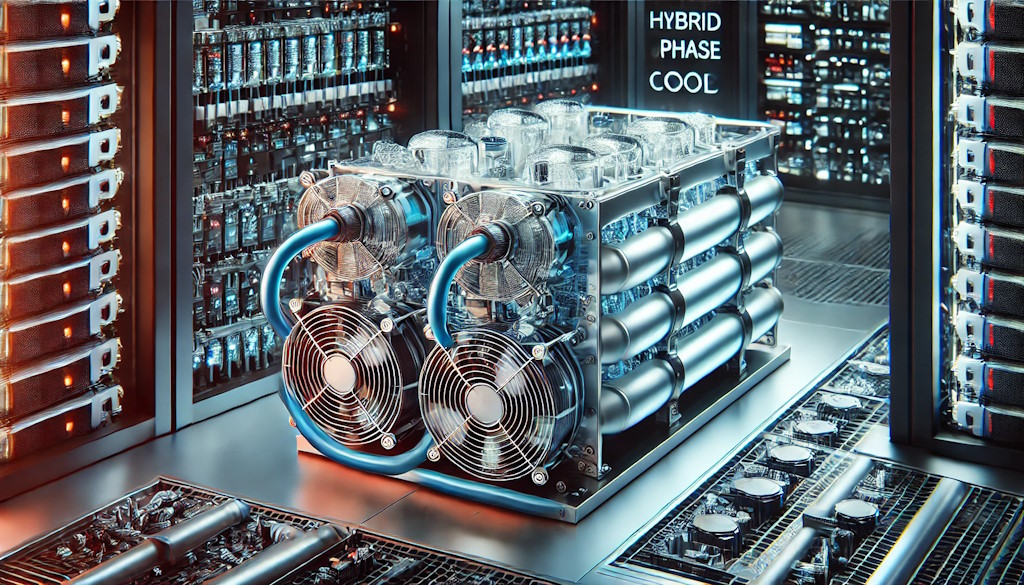
 Karlobag.eu / AI illustration
AI illustration — this image is not a real photograph and does not depict an actual event. What does AI illustration mean?
Artificial intelligence (AI) is currently a very topical subject, as are the data centers that drive this technology. Cooling these centers requires enormous amounts of energy.
As high-energy AI computers and devices become commonplace, the problem will only grow. That’s why researcher Chanwoo Park from the University of Missouri is developing a new cooling system that promises to drastically reduce energy demands.
Cooling and chip manufacturing
“Cooling and chip manufacturing go hand in hand,” said Park, a professor of mechanical and aerospace engineering at the Mizzou College of Engineering. “Without proper cooling, components overheat and stop working. Energy-efficient data centers will be key to the future of AI computing.”
Solving future problems
Data centers are large buildings full of servers that contain computer chips for storing and processing data. They are the basic computing centers that power websites, mobile applications, and cloud data.
They are also huge energy consumers. In 2022, data centers used more than 4% of the total electricity in the USA, with 40% of that energy spent on cooling equipment. As demands for data centers increase, even greater amounts of energy will be needed.
To mitigate this, the US Department of Energy has awarded more than $40 million to researchers to find new ways to cool data centers. Park recently received nearly $1.65 million from this initiative, known as COOLERCHIPS.
Currently, data centers are cooled using fans to move air or liquid that carries heat away from the computer racks.
Park and his team are developing a two-phase cooling system designed to efficiently remove heat from server chips through phase change, such as liquid evaporation into vapor in a thin, porous layer. The system can operate passively without consuming energy when less cooling is needed. Even in active mode, where a pump is used, only a negligible amount of energy is consumed.
Efficient heat transfer
“The liquid moves in different directions and evaporates on a thin metal surface,” Park said. “Using this boiling surface, we can achieve very efficient heat transfer with low thermal resistance.”
The system also includes a mechanical pump that activates to absorb more heat only when needed.
Early tests show that two-phase cooling techniques drastically reduce the amount of energy needed to cool equipment.
The team is currently building a cooling system designed for easy connection and disconnection within server racks. Park hopes it will be in use in the next decade, just as AI-powered computers become mainstream.
“Eventually, there will be limitations to current cooling systems, and that’s a problem,” Park said. “We’re trying to stay ahead of the curve and have something ready and available for the future of AI computing. This is a futuristic cooling system.”
Park’s work aligns with the goals of the Center for Energy Innovation, a building under construction on campus to enable interdisciplinary researchers to address the challenges posed by growing energy needs and the rapid growth of AI technology. The idea is to leverage advanced technology to optimize energy production, storage, and efficiency.
“The center will allow us to explore additional ideas and innovations around energy-efficient processes,” Park said. “These are complex problems that require different areas of expertise. I look forward to future collaborations.”
Additionally, Park’s cooling method involves an advanced capillary structure within the evaporator that allows the creation of thin layers of liquid that easily evaporate, enabling efficient heat removal from server chips with minimal thermal resistance.
The system uses a hybrid design that combines capillary and mechanical pumping. Within the evaporator, the capillary structure creates thin layers of liquid that evaporate for efficient heat removal from server chips with minimal thermal resistance. Mechanical pumping simultaneously enhances the cooling capacity by absorbing significant amounts of heat.
“Using this hybrid design, we are creating an ideal solution for cooling data centers,” said Park. “It’s very challenging and requires a lot of analysis and development. It involves advanced manufacturing techniques, but it’s designed to handle large heat fluxes with low energy consumption. It’s very close to the ideal cooling system we are looking for.”
Park is five months into a three-year project. The ultimate goal is to find a system that can be commercialized and mass-produced for use in high-tech data centers. He is optimistic that the partnership with the government and industry will result in significant commercialization.
“Thanks to collaboration with national laboratories and industry partners, we are making significant advances,” Park emphasized, highlighting the successful achievement of initial milestones. “Ultimately, I am optimistic that this cooling system will be adopted in data centers to improve overall efficiency.”
The University of Missouri is committed to addressing the challenges posed by growing energy needs and the rapid growth of artificial intelligence through the Center for Energy Innovation, a building that will bring together engineers, agronomists, physicists, chemists, and public policy experts to provide sustainable solutions for the future and strengthen domestic energy supplies.
Source: University of Missouri
Note: This content was prepared with the assistance of artificial intelligence tools. The content was editorially reviewed before publication.