Postavke privatnosti

Flooding in the Sahara: a rare phenomenon is transforming the desert landscape and bringing an unprecedented amount of water

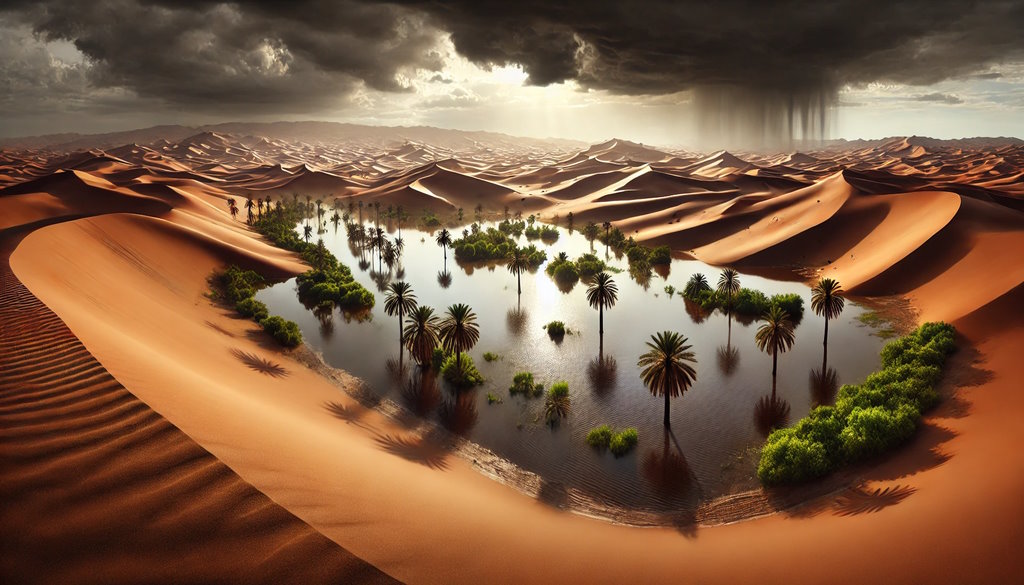
Rare floods hit the Sahara Desert, bringing water to parts that had not seen rain for decades. The transformation of the landscape has created temporary lakes and green cover in the most unusual natural phenomenon.

Flooding in the Sahara: a rare phenomenon is transforming the desert landscape and bringing an unprecedented amount of water
Photo by: Domagoj Skledar/ arhiva (vlastita)

Unusual floods in the Sahara desert: transformation of the landscape after decades of drought


One of the most unusual meteorological events in the history of the Sahara occurred in early October 2024, when parts of southeastern Morocco experienced a rare and intense rainstorm. Over two days, regions such as Tagounite and Tata, which are typically known for their extremely dry conditions, received over 100 millimeters of rain in just 24 hours. This extreme weather phenomenon triggered torrents that completely transformed the desert landscape, creating lakes and streams where only sandy dunes existed before.


Climate causes and global impact


Meteorological experts from Morocco believe that the main cause of this unusual storm was the warming of the Atlantic Ocean, which acted like an "humidifier" for the air, adding additional moisture to the atmosphere. An extratropical cyclone pulled this moisture southward, causing heavy precipitation in areas that usually receive less than 250 millimeters of rain annually. Additionally, the shifting of the Intertropical Convergence Zone (ITCZ) due to global warming also contributed to the accumulation of rainfall in parts of North Africa that typically do not experience such amounts of precipitation.


Impact on local communities and the environment


For local communities in Morocco, the floods were a double-edged sword. On one hand, the intense rain temporarily alleviated the prolonged drought affecting these regions, resulting in the replenishment of aquifers, vital sources of drinking water and agriculture. Water reservoirs in the region reported record levels of fullness, temporarily securing more water for local agriculture and communities.


On the other hand, the damage caused by the floods was significant. Floods destroyed roads and homes, and more than 20 people died in Morocco and Algeria. Farmers, who were already facing the consequences of prolonged drought, now had to watch as their crops were destroyed by excess water. Many livestock had to be relocated, and agricultural production across large parts of the region was seriously threatened.


Ecological consequences: opportunities and risks


While the floods brought desperately needed water, they also posed risks to the desert ecosystem. Soils in deserts are extremely fragile, and a sudden influx of water can cause erosion, stripping away the topsoil upon which plants and farmers depend. This process can leave long-lasting consequences, making it difficult to cultivate plants in the future.


Moreover, desert ecosystems are adapted to extreme dryness. A sudden rise in water levels can disrupt these delicate systems. While some plant and animal species may take advantage of new water sources, others could struggle to survive in altered conditions. Lake Iriqui, which had been dry for over 50 years, is now once again filled with water, but it remains uncertain whether this change will benefit local plant and animal species in the long term.


Climate change and future extreme weather events


This event has drawn the attention of scientists worldwide as it fits into a broader pattern of extreme weather phenomena linked to climate change. As the atmosphere warms, it holds more moisture, which can result in stronger and more intense storms even in areas that are usually dry like the Sahara. Experts warn that floods in deserts, though rare, could become more frequent in the future.


The unpredictability of such weather events further highlights the vulnerability of desert regions and the communities living within them. Most residents in deserts are unprepared for large amounts of rain, and infrastructure in these areas is not designed for such extremes. If these events continue, they could permanently alter the landscape and way of life in the Sahara. Preparation and adaptation to these new realities are becoming crucial for communities that rely on the scarce resources of the desert ecosystem.

Find accommodation nearby

Creation time: 28 October, 2024

Magazine editorial office

The magazine’s editorial team brings together authors who have lived with stories, aesthetics and creative processes for decades. Here, texts are created and shaped by experience gained through years of work in journalism, but also by a personal passion for design, lifestyle, fashion and entertainment. Every written line comes from people who closely observe the world, with respect for detail and an understanding of how trends evolve, disappear and return in new forms.

Our editorial team believes that good magazine content must have a soul — a tone that guides the reader through the topic rather than overwhelming them with facts. That is why we write slowly, thoughtfully and with an emphasis on atmosphere. Whether we explore the world of interiors, shifts in fashion, new ideas in beauty or compelling stories from everyday life, we strive for every word to convey a real experience, not just information.

At the center of our work are people: those who create, those who inspire and those whose stories lie hidden beneath the surface of everyday life. We love to look behind the scenes, to discover processes that aren’t visible at first glance, to feel the energy of places and objects. We write about icons and trends, but also about the small things that shape our routines, about creativity born from an ordinary day, and about ideas that spark change.

Over the years we’ve learned that magazine content should be more than a review of news. It should be a space where the reader feels calm, inspired and curious. That’s why we approach every topic as a small story of its own. Sometimes it is an analysis of design that shapes the aesthetics of contemporary life, sometimes an intimate portrayal of emerging beauty rituals, and sometimes a light, relaxed look at trends just beginning to appear in culture.

In our Editorial Team we believe that quality comes from honesty and dedication. That’s why we cultivate a writing style that is natural, warm and editorially refined — without haste, clichés or superficial conclusions. Our editorial approach is built on knowledge, experience and years of working with text, and every article comes from genuine reflection rather than automatic routine.

Our mission is simple: to create content that is memorable, that resonates and that leaves a mark. A magazine is not just a collection of topics, but a space for exploration, dialogue, aesthetics and stories that deserve to be told. That is why the Magazine Editorial Team remains committed to delivering reliable, inspiring and sincerely crafted content to its readers.

NOTE FOR OUR READERS
Karlobag.eu provides news, analyses and information on global events and topics of interest to readers worldwide. All published information is for informational purposes only.
We emphasize that we are not experts in scientific, medical, financial or legal fields. Therefore, before making any decisions based on the information from our portal, we recommend that you consult with qualified experts.
Karlobag.eu may contain links to external third-party sites, including affiliate links and sponsored content. If you purchase a product or service through these links, we may earn a commission. We have no control over the content or policies of these sites and assume no responsibility for their accuracy, availability or any transactions conducted through them.
If we publish information about events or ticket sales, please note that we do not sell tickets either directly or via intermediaries. Our portal solely informs readers about events and purchasing opportunities through external sales platforms. We connect readers with partners offering ticket sales services, but do not guarantee their availability, prices or purchase conditions. All ticket information is obtained from third parties and may be subject to change without prior notice. We recommend that you thoroughly check the sales conditions with the selected partner before any purchase, as the Karlobag.eu portal does not assume responsibility for transactions or ticket sale conditions.
All information on our portal is subject to change without prior notice. By using this portal, you agree to read the content at your own risk.