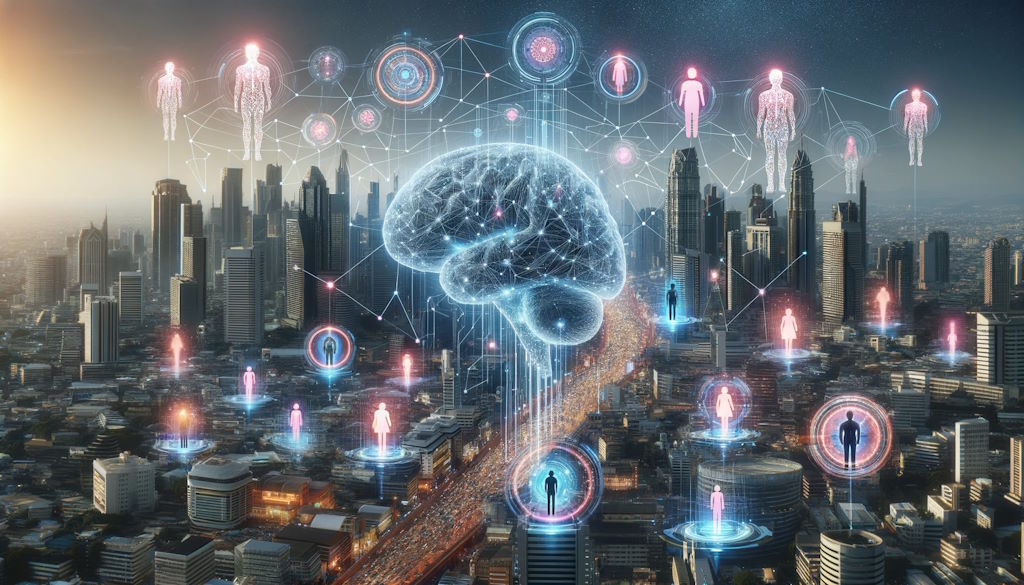
 Karlobag.eu / AI illustration
AI illustration — this image is not a real photograph and does not depict an actual event. What does AI illustration mean?
Neuralink, a company founded by Elon Musk in 2016, has the ambitious goal of implanting technology into the human brain that would allow control of computers or mobile phones with just thoughts. This technology is known as a brain-computer interface (BCI).
After years of experiments on animals, Neuralink recently announced the implantation of one of its devices in the human brain. Neurotechnology, as a branch of technology, promises to alleviate human suffering and enable people with disabilities to regain lost abilities.
The question arises: will people without disabilities also embrace technology that connects directly with their brains and nervous systems? What could happen in the future if people could connect their brains with devices, infrastructure, and even other people through a kind of brain-computer internet?
It's time to think about these questions. Medical conditions such as locked-in syndrome prevent people from communicating or moving their limbs. Neuralink's device is initially intended to restore these abilities to people with such conditions by controlling a computer cursor for communication or using a robotic arm for feeding.
The company's long-term goals, as outlined by Musk, include the ability to summon an autonomous vehicle with just thoughts. These goals suggest that neurotechnology could connect people with various technological systems that are currently in everyday use.
A brain-computer interface (BCI) detects electrical activity in the brain associated with a person's intentions. For example, if a person wants to move a cursor to the right, they can imagine waving their hand. This brain activity is decoded and translated into a command for the cursor.
This approach can work with a robotic arm, lights in a smart home, a video game, or even a drone or robot. BCI can be considered a universal controller or, as prominent neuroscientist Professor Rafael Yuste described it, an iPhone for the brain.
Neurotechnology can be invasively implanted into the brain or nervous system or come in the form of wearable technology, such as headsets or earbuds. Air traffic controllers with external headsets may have their brains monitored to alert them when their attention levels drop.
In Chinese middle schools, systems are already being used to monitor students' brain activity by teachers. Brainwave Science offers a product to security services and police that can track the brain activity of suspects during interrogation.
However, things could go even further, as forms of direct brain-to-brain communication are being tested. Instead of calling a friend or sending a message, one day you might communicate telepathically. Rudimentary forms of direct brain-to-brain communication between humans (and even between humans and different animals) have already been achieved.
Various militaries are also interested in the potential of "super soldiers" enhanced with neurotechnology, as they could operate more effectively in demanding environments, such as urban areas. This would include weapons systems, sensors, and monitoring the brains of military personnel in a distributed battlefield control system. A particularly striking example of this approach comes in the form of mind-controlled robotic dogs, recently demonstrated by the Australian military.
This is reminiscent of the fictional Borg civilization from Star Trek, which features a similar blend of biology and machines. The alien Borg are individuals connected by neurotechnology who operate together as an entity. The implications of an interconnected system of humans and machines enabled by neurotechnology are something we should start thinking about, along with the values such a society might have.
We can imagine different scenarios. In the future, it is possible that those managing critical infrastructure in cities could have their brains monitored to prevent accidents. People with mobility issues could increasingly communicate with devices in their homes, including turning lights on and off and controlling home robots via a brain-computer interface.
At some point, people without disabilities might also decide to forgo manual remote controls and instead control devices with their brains. Prisoners and offenders in the community could be monitored in real time to assess their mental state.
Over time, these separate applications could start creating interconnections for improved efficiency, commercial benefits, and social control. Neurotechnology could become a key infrastructure that becomes the main interface for human relationships with technological systems.
From all this, it is clear that we need to think about human rights and the broader legal implications of neurotechnology. However, much of the debate is quite individualistic and ignores the broader social implications of changing human relationships with technological systems.
Therefore, a discussion about the greater purpose of neurotechnology, its use, and implications is needed. This requires contributions from various groups, such as infrastructure experts, designers, architects, human-computer interaction specialists, and community groups.
Neurotechnology is likely to have different effects on society: in the home, in the workplace, in the criminal justice system, and in infrastructure networks.
Considering the emerging issues in these different sectors should enable us to anticipate the harms and benefits of neurotechnology. This will allow us to shape its development to support people and the environment.
To paraphrase the Borg: resistance may not be futile after all.
Original:
Simon Marvin
Director of the Urban Institute at the University of Sheffield
Allan McCay
Academic Fellow at the Law School at the University of Sydney
Note: This content was prepared with the assistance of artificial intelligence tools. The content was editorially reviewed before publication.