 Karlobag.eu / AI illustration
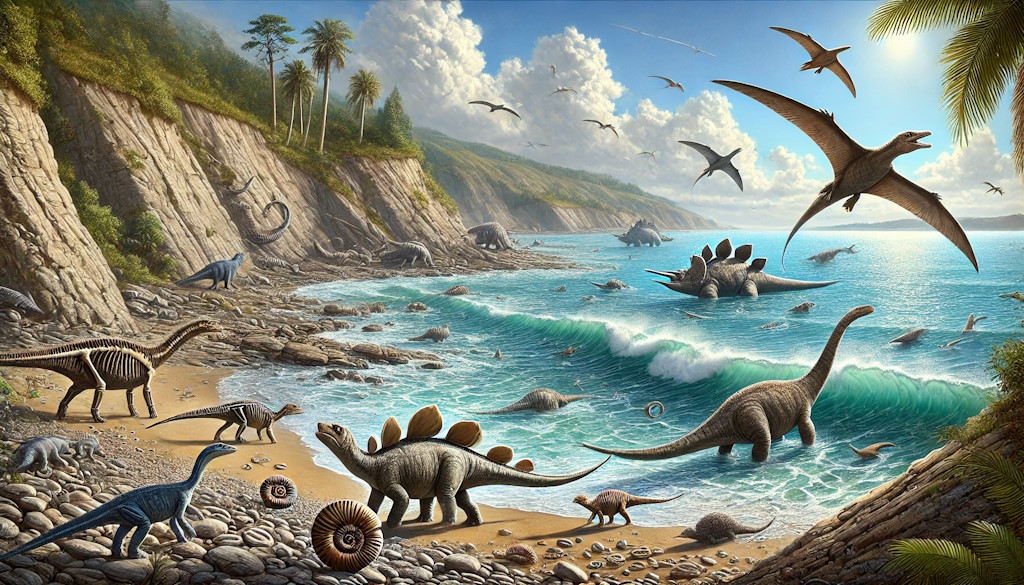
AI illustration — this image is not a real photograph and does not depict an actual event. What does AI illustration mean?
A new discovery from Nevada, USA, is changing our understanding of life along the shores during the Triassic. In the Favret formation, a new species of an extinct relative of the crocodile, Benggwigwishingasuchus eremicarminis, has been found. This discovery shows that pseudosuchian archosaurs inhabited coastal regions worldwide during the Middle Triassic, between 247.2 and 237 million years ago.
Global Presence of Pseudosuchians
"This new species demonstrates the global presence of pseudosuchians in coastal habitats during the Middle Triassic," said Dr. Nate Smith, lead author of the study and director of the Dinosaur Institute at the Natural History Museum of Los Angeles County.
The Favret formation, known for fossils of marine creatures like ammonites and the giant ichthyosaur C. youngorum, surprised researchers with the discovery of a land animal in marine sediments. Co-author Dr. Nicole Klein stated: "Our first thought was, 'What the heck is this?' We expected marine reptiles, not a land animal among ichthyosaurs and ammonites."
Adaptation to Coastal Habitats
Pseudosuchian archosaurs have already been found along the coasts of the ancient Tethys Ocean, but this is the first coastal specimen from the Panthalassic Ocean and the Western Hemisphere, revealing their presence worldwide. Interestingly, these species are not from the same evolutionary group, suggesting independent adaptation of different pseudosuchians to coastal habitats.
"During the Middle Triassic, various archosauriform groups were attempting to adapt to coastal life," Smith said. However, most of these adaptations did not result in a broader spread of semi-aquatic groups.
Diversity of Archosauriforms
During the Triassic, archosaurs, the "ruling reptiles," emerged and divided into two groups with two surviving representatives: birds, descendants of dinosaurs, and crocodiles (alligators, crocodiles, and gavials), descendants of pseudosuchian archosaurs like B. eremicarminis. While today's crocodiles are similar enough for most people to confuse them with one another, their ancient relatives varied greatly in size and lifestyle. The evolutionary relationships of B. eremicarminis and its relatives suggest that pseudosuchians achieved great diversity very quickly after the mass extinction at the end of the Permian, the extent of which is yet to be uncovered in the fossil record.
New Species B. eremicarminis
The new species highlights the multitude of these ancient reptiles during the Triassic, from giants like Mambawakale ruhuhu to smaller animals like the newly described species B. eremicarminis, which probably reached a length of about 1.5 to 1.8 meters. The exact length of B. eremicarminis and how it survived along the shore remain unclear. Only a few skull elements have been found, and clues about its diet and hunting methods are also missing. It is clear that B. eremicarminis likely stayed close to the shore. Its well-preserved limbs are developed without signs of adaptation to aquatic life such as fins or modified bone density.
Name and Significance
The research team wanted a name that honors the original human inhabitants of the Augusta Mountains where the specimen was found, and consulted with a member of the Fallon Paiute Shoshone tribe to choose an appropriate name. "Benggwi-Gwishinga," meaning "to catch fish" in the Shoshone language, was combined with the Greek word for Sobek, the Egyptian crocodile-headed god, to create the new genus, Benggwigwishingasuchus. The specific epithet eremicarminis translates to "desert song," honoring two NHMLAC supporters with a passion for paleontology and southwestern opera. Thus, the full name roughly means "Desert Crocodile Fisherman's Song."
This surprising discovery opens a new perspective on biodiversity during the Middle Triassic, shedding light on the significant role of pseudosuchians in shaping the ancient world and suggesting many untold stories hidden in the fossil record.
Triassic Ecosystems
The discovery of B. eremicarminis provides valuable insights into the coastal ecosystems of the Triassic. These ecosystems were complex and diverse, hosting various forms of life from marine reptiles like ichthyosaurs to terrestrial pseudosuchians. The presence of B. eremicarminis suggests that coastal habitats were crucial in the evolutionary history of these archosaurs, providing them with resources and niches that allowed them to survive and adapt.
Implications for Modern Conservation
Studying extinct species like B. eremicarminis offers lessons for modern conservation efforts. By understanding how ancient animals adapted to their environments and survived significant climatic and geological changes, scientists can draw parallels with current challenges facing modern wildlife. The resilience and adaptability of Triassic species highlight the importance of conserving diverse habitats and promoting ecological resilience in our present-day ecosystems. This historical perspective can guide conservation strategies aimed at mitigating the impacts of climate change and habitat destruction, ensuring the survival of today's species for future generations.
Source: NATURAL HISTORY MUSEUMS OF LOS ANGELES COUNTY
Note: This content was prepared with the assistance of artificial intelligence tools. The content was editorially reviewed before publication.